



By Ike Abonyi.
In many of Prof. Chinua Achebe’s novels, he used proverbs to deepen his message. For instance, ‘having the yam and the knife’ means that someone has complete control, absolute power or the total ability to decide how a resource or situation is handled.
In Nigeria and West African contexts, such as Igbo or general political parlance, the yam represents the resource or sustenance and the knife represents the tool to slice and distribute it.
Whoever holds both items decides who gets a share, how much they get and when they get it. It is often used to describe wealthy leaders, powerful figures or deities, who dictate the terms of an outcome. Achebe used proverbs mostly to show the absolute power of the colonial masters, who controlled everything then.
The spirit of Western democracy, which we practise removes such power from any individual or group and rests it on the people using their voting power. The truth is that certain individuals and groups exert some influence, but the absolute determinant rests with the people. Anywhere or at any time the absolute power leaves the people, then democracy is hindered.
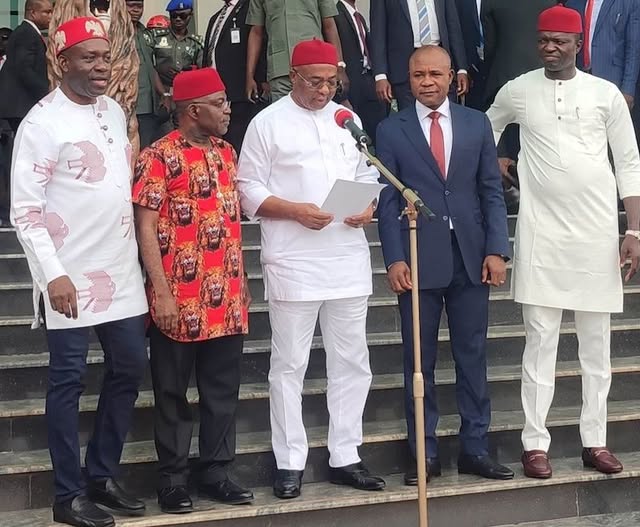
Ahead of the January 16, 2027, presidential election, the South-East Governors have been posturing themselves as having the yam and the knife as far as where the Igbo will cast their votes is concerned.
It was these errors in political judgment that made them abandon their people to embrace the ruling All Progressives Congress (APC), which the region roundly rejected in 2023, in their wrong understanding that Tinubu has both the yam and the knife over the 2027 poll.
But, they will all be shocked to learn, in the hard way, that the people of the South East, not Tinubu or governors, will decide the outcome of the January 16, 2027 poll. The people demonstrated that in 2023 and they will repeat it in 2027 because they are already seeing an Igbo man at the gate of Aso Rock.
There are two the reasons nobody in the South-East is losing sleep over the sabotaging position of South-East governors against Obi. One is because none or all of them combined are not in control of the voters in the region; two is that history is a witness to how inglorious persons sabotaging the Igbo cause end.
A realistic path to victory for Obi in 2027, even with all the five South East state governors explicitly aligning with President Bola Tinubu and the ruling party—hinges on a clear electoral truth in Nigeria: state governors do not own individual votes, particularly in high-turnout presidential elections. In most government houses in Enugu, Awka, Owerri, Abakaliki and Umuahia, Obi will defeat Tinubu unless the votes are not counted.
In 2023, Obi won sweeping majorities across the South East despite controlling zero state governments at the time. The premise that state executive machinery guarantees a presidential vote underestimates the organic nature of voter sentiment when citizens feel alienated by incumbent leadership.
The South-East governors may control state governments, but they do not control the votes of the people. That distinction could become one of the defining political questions of the 2027 election.
Governor Hope Uzodimma of Imo State has said that the five South-East governors resolved to support Tinubu’s re-election. Nobody is losing sleep over that because that is just five votes, because in Anambra, for instance, Governor Soludo’s son, Ozonna is not likely to vote where his father votes, on the presidency; ditto in other states.
Already, Governor Alex Otti has publicly rejected the suggestion that Uzodimma could speak for the five governors and stressed that the decision ultimately belongs to voters.
This exposes a fundamental distinction between the political establishment and the electorate.
The argument that Obi cannot prevail without the governors assumes that governors can simply transfer their political structures, influence and supporters to another presidential candidate. But, the 2023 election demonstrated that the South-East electorate could move overwhelmingly in a direction different from the preferences of many political elites: Obi won the five South-East states under the Labour Party.
The more important question for 2027, therefore, is not which governors endorse Obi, but whether their political choices correspond with the mood of their people.
The ‘knife and yam’ adage used here copiously captures a longstanding Nigerian political calculation: stay close to whoever controls the federal machinery because he controls the immediate distribution of political rewards and risks.
That calculation can produce an apparent political paradox. Governors may believe that proximity to the presidency is safer for their political survival than confrontation with it.
Analysts have similarly identified federal leverage, political marginalisation and survival considerations as factors behind the movement of governors towards the APC, but presidential elections are ultimately decided by voters.
Consequently, a governor’s alliance with the presidency should not automatically be interpreted as an equivalent alliance between the electorate and the presidency.
In conclusion, the holder of the piper can call the tune but get a drowning ovation from the crowd, which is what awaits Oti (Abia), Soludo (Anambra), Nwifuru (Ebonyi), Mbah (Enugu) and Uzodimma (Imo) on January 16, 2027. God have mercy.
Abonyi, editor @large, writes from Abuja


More Stories
The indignity of a hero: The Professor Aghaji story
Debunking the lie ‘our votes don’t count’
Obi: The candidate Nigeria needs but the system fears